preop 2 years postop
本診所張醫師最新論文"困難朝天鼻整形的新方法----鼻中隔尾端前移術的應用",已經榮獲美國美容外科醫學會雜誌(Asthetic Surgery Journal)接受,於2010年4月出刊.
原文請參考: http://dx.doi.org/10.1177/1090820X10366548
Correction of Difficult Short Nose by Modified Caudal Septal Advancement in Asian Patients
Yean-Lu Chang, MD
Dr. Chang is in private practice in Taipei, Taiwan.
Yean-Lu Chang, MD, Toyoung Plastic Surgery Clinic, 4th Floor, No. 72, Sec. 2, Xin-Yi Road,
Taipei, Taiwan. E-mail: chang157@gmail.com
Objective: The author presents his two-year aesthetic results from the treatment of difficult short noses with the modified caudal septal advancement method.
Methods: From November 2006 to August 2008, 41 patients (ages 23-59 years) with a short nose were treated with modified caudal septal advancement, with or without extracorporeal septoplasty.
Results: Among the 36 patients who remained for six months to two years of follow-up, 20 patients achieved “excellent” results and 12 patients showed “good” results, both based on nasal lengthening measurements taken by the author. Four patients had only “fair” results. Patients in this last group, including three with overlengthening and one with inadequate elongation, required revision surgery.
Conclusions: In the Asian population, when short-nosed patients present with weak or deviated caudal septums or a limited supply of donor conchal or septal cartilage, the modified caudal septal advancement method can more predictably and efficiently provide a stable nasal base support than the conventional extension grafts, spreader grafts, or extended spreader grafts. The author believes that this technique is a safe, effective, and reliable alternative to costal cartilage grafts in dealing with difficult short noses.
[本文]
The short nose, characterized by a reduced distance from the nasal radix to the tip,1 has represented one of the greatest challenges in rhinoplasty. Conventionally, several techniques have been described for correction of the short nose, including extension grafts,2 spreader grafts, and extended spreader grafts.3 By joining to the stable caudal nasal septum, these grafts increase the nasal length. Therefore, the caudal nasal septum is considered the most important anatomic structure for providing nasal support. According to Newton’s third law, for every action force, there is an equal (in size) and opposite (in direction) reaction force. Likewise, in short nose correction, a reaction force will be generated after the lengthening procedure. Therefore, more stable nasal support is necessary to resist the reaction force (Figure 1). In Caucasian individuals, the remaining nasal septum is thick enough to endure the reaction forces resulting from nose elongation. However, in Asian patients, the septal cartilage is much smaller, thinner, and shorter.4 Especially when a patient with a short nose exhibits a scanty, flimsy, pliable, or deviated septum, the application of the conventional caudal extension grafts, spreader grafts, or extended spreader grafts will lead to a more unstable nasal base. Without stable nasal support, tip ptosis, caudal nasal deviation, and subsequent failure of the elongated nose will develop (Figure 2). We define these situations as “difficult short nose.” On the basis of the concept previously described by Dini and Ferreira,5 the author modified his nose elongation technique—called caudal septal advancement, with or without combined external septoplasty—to treat the difficult short nose. This article reports the author’s experience in treating Asian patients with short noses, the complications encountered during a two-year observation period, and the aesthetic results.

Figure 1. When an extension graft is fixed to the caudal septum, a reaction force will be generated simultaneously (arrows). Reprinted with permission.

[方法]
From November 2006 to August 2008, 41 patients (ages, 23-50 years) with a short nose were treated by caudal septal advancement. Of the 41 patients, four were lost to follow-up and one patient contracted an infection resulting in removal of the Gore-Tex and refused further rhinoplasty, leaving only 36 patients available for follow-up. Twelve patients were classified as having a primary short nose and 24 patients as having a secondary short nose. Three patients with saddle nose in conjunction with a short nose were also included in this series. The indications for surgery included (1) a short nose with a flimsy or pliable caudal septum that was unable to withstand the reaction force induced by nose elongation, (2) a short nose with caudal septal deviation that was judged intraoperatively to be unable to provide a stable nasal support after nose-lengthening procedures, and (3) a short nose with borderline limited supply of donor conchal or septal cartilage. The preoperative evaluation included physical examination and computer image simulation using Mirror imaging systems (Canfield Scientific, Inc, Fairfield, New Jersey).
Through an open approach, extensive undermining of the nasal skin and radical release of the lower lateral cartilage from the upper lateral cartilage were performed. Subsequently, the central-posterior septal cartilage was resected, to be used as a spreader graft.6 The L-shaped caudal septal component was then removed from its attachments around the nasal spine. To avoid destabilization of the middle nasal vault, the surgeon preserved a stable dorsal strut at least 1.5 cm in length along its anteroposterior axis and 1 cm in width (Figure 3A). Caudal septoplasty was then performed to strengthen and straighten the weak or deviated caudal septum. The batten graft was harvested from the resected central-posterior septum or conchal cartilage, depending on the availability of the donor cartilage. The reconstructed L-shaped caudal septum was reintroduced, with its inferior aspect sutured to the periosteum around the nasal spine or to the cancellous nasal spine by drilling two holes with a 21-gauge needle. Fixation was necessary to prevent the caudal septal strut from slipping out of the midline.5 The spreader grafts that were harvested from the thickest posterior septal base6 or thinner central septum were then placed. When the donor septal cartilage was too small or depleted, the conchal cartilage graft was chosen. In some patients who had a prior extension grafting procedure, the extension graft was carefully dissected and recycled as spreader grafts. The spreader grafts were fixated to the dorsal strut at the keystone area and L-shaped caudal septum, respectively. Finally, nose elongation was completed, with the medial crura sutured to the caudal margin of the advanced septal graft.

In this series, all patients also presented with underdeveloped nasal dorsum, which is very common in Asian patients. We chose Gore-Tex (expanded polytetrafluoroethylene or ePTFE; W. L. Gore & Associates, Inc, Flagstaff, Arizona) for dorsal augmentation because of its high tissue compatibility.7 The 2-mm-thick Gore-Tex was stacked in multiple layers as necessary and sutured into position with the open approach, and a tip cartilage graft was then implanted (Figures 3B and 4).

[ 結果 ]
Patients were scheduled for follow-up at three months, six months, and then every six months thereafter. All patients were evaluated in person by the author. Patient photographs taken at each visit were also analyzed and compared. The amount of nasal lengthening varied, ranging from 2 to 8 mm depending on the final nasal length desired. Measurements were obtained and the results were classified into four groups.3 “Excellent” results indicated that the preoperative aesthetic goals were achieved completely. The outcome was defined as “good” if the nasal length was within 1 mm (shorter or longer) of the planned length. The result was judged as “fair” when the nasal length was 1 to 2 mm too short or too long. Any nasal length over 2 mm shorter or longer than the planned length was classified as “poor.”
Among 36 patients with six months to two years of follow-up, 20 patients achieved “excellent” results (Figures 5, 6, and 7), and 12 patients showed “good” results. Four patients were classified as “fair.” These four patients, including three with overlengthening and one with inadequate elongation, required revision surgery. In the overcorrected cases, the caudal part of the advanced septum was trimmed accordingly. In the undercorrected nose, more conchal cartilage grafts were added to the nasal tip and columella. When smiling, one patient had a “click” in the nasal spine area that required refixation of the base of the caudal septum to the nasal spine. No instances of caudal nasal deviation or destabilization occurred.

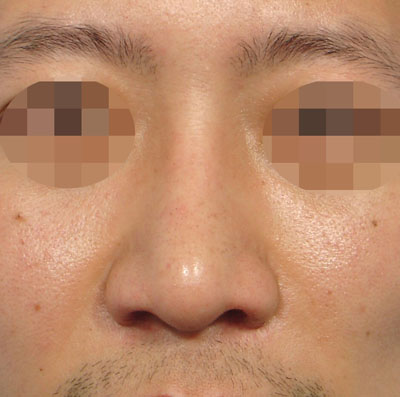

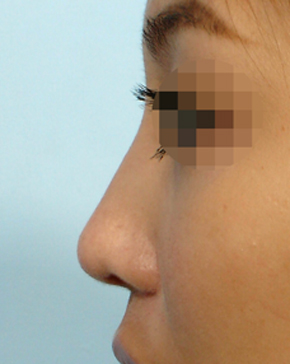
Figure 6. A 22-year-old woman who complained of caudal nasal deviation and recurrent short nose after septal extension grafting and Gore-Tex implantation one year previously. Two years after the patient's second surgery, involving augmentation rhinoplasty with caudal septal advancement and external septoplasty because of a nearly depleted donor central septum and a pliable caudal septum. A piece of cartilage from the posterior septum was used as a batten graft to enhance the strength of the caudal septum. The spreader graft was composed of recycled previously-implanted extension graft and conchal cartilage graft. Gore-Tex to the nasal dorsum and a conchal cartilage graft to the tip were applied as well. The patient also received a mastoid fascia-fat graft to her nasal tip seven months prior to these photos to correct skin thinning on the nasal tip.


preop 2 years postop
Figure 7.A 28-year-old woman who complained of severe contracted nose after previous silicone augmentation rhinoplasty. Low-grade infection was suspected. Three months after removal of the silicone implant, the short nose was improved. Two years after reaugmentation rhinoplasty with caudal septal advancement and external septoplasty because of a pliable caudal septum and a nearly depleted donor central septum. Two pieces of conchal cartilage served as a batten graft to enhance the strength of the caudal septum. The spreader grafts consisted of a conchal cartilage graft and a septal graft harvested from the posterior septum. Gore-Tex to the nasal dorsum and a conchal cartilage graft to the tip were applied as well.


